(209) 333-8016

William V. Huiras, DDS
322 West Lodi Ave.
Lodi, CA 95240

Our Blog

What are Dental Crowns?

June 13th, 2013

A dental crown is often called a “cap.” A dental crown covers all of the visible parts of the tooth and has many functions and reasons for placement.

There are several different types of crowns available at William V. Huiras D.D.S. They vary in their material, appearance, and functionality. A PFM, or porcelain fused to high-noble metal, is the most common. A full cast, high noble metal crown is a gold crown, and a stainless-steel crown is meant to be temporary. The most natural-looking crown is one that is all porcelain. These are often used for front teeth.

Getting a crown typically requires two appointments. The first is a preparation with impressions, shaping, and placing a temporary. The impressions are either sent to a dental lab, where the process generally takes two weeks, or done in-office with a machine that can make a crown without needing a second appointment. These crowns are made from a high-quality solid block of porcelain. The shape of the tooth is constructed from a digital 3D image of your tooth.

To accurately determine which type of crown is best, you must first know why you need the crown and in what area of your mouth is it needed, which can be answered when you visit us at William V. Huiras D.D.S. For instance, if you have a gold crown on the lower right and need a new crown directly above on the upper right, the best durability and long-lasting relationship is another gold crown.

If you need a crown on a front tooth, a gold crown may not be the best choice. A PFM has strength but is not ideal, as a dark line will appear at the gum line. A full porcelain crown is going to look as close to a natural tooth as possible, but will have less strength than a gold crown.

There are two types of porcelain crowns, depending on how they are made. A dental lab makes a full porcelain crown by baking layer upon layer to make the porcelain look like natural enamel. A full porcelain crown made in-office out of a solid piece of porcelain will have increased strength. However, the natural layered appearance is extremely difficult to achieve.

A crown is placed on a tooth when added strength is needed. Cracks, large broken-down fillings, or previous root canal treatment are all conditions where a crown is the standard care. The type of crown that is most appropriate depends greatly on location.

June Marks National Dairy Month!

June 6th, 2013

In honor of June being Dairy Month, Dr. Huiras and our team at William V. Huiras D.D.S would like to remind our patients about the importance of dairy to your overall health! Regular consumption of dairy products, such as milk, cheese, and yogurt, has been found to lower your chances of contracting gum disease (also known as periodontal disease).

Those who consume at least 55 grams of lactic acid a day are less at risk for gum disease. Eating dairy is not just healthy for building strong bones, but is essential for maintaining a strong, healthy mouth and a smile that will last a lifetime.

Questions about which foods you should steer clear of and which you should enjoy? Give us a call or ask us on Facebook!

When Should a Filling be Replaced?

May 30th, 2013

There is no substitution for a natural healthy tooth. Dental fillings are intended to replace tooth structure and restore a tooth damaged by decay (a cavity) back to its normal function and shape. Silver (amalgam) and tooth-colored (composite) fillings last a long time, though they can develop decay when the integrity is compromised by open margins, fracture, or recurrent decay. In this blog, we discuss the signs and symptoms that indicate your filling may need to be replaced in order to prevent further complications.

Amalgam fillings are made of an alloy (mixed metals) that expands and contracts. They have no bonding properties, and so to place an amalgam filling, the hole in the tooth may need to be larger. Because of these two factors, fractures frequently occur. There are three types of cracks that are commonly associated. Craze lines are superficial with no treatment needed. Fractures extend along other parts of the tooth and may require a filling replacement or crown. Cracks extend toward the root and can require a root canal and crown or, if too severe, extraction.

A filing needs to be sealed to the tooth. If the seal between the tooth and the filling breaks down, food debris and bacteria can seep down under the filling and cause recurrent decay. If the decay is treated early, replacing the filling is adequate. If not, a crown and even a root canal may be needed. The biggest mistake you can make is waiting to do something about a broken or unsealed filling until it is painful. Doing this will only make the treatment more involved and often times more expensive.

Regular dental exams and X-rays are used to evaluate dental fillings. You will not be able to tell on your own when your fillings start to fail. Just as a car mechanic will change the oil, correct your alignment, or change your tires, a dental checkup will help you identify small concerns to fix as you go in order to avoid a critical emergency.

Pay attention to any bite or temperature sensitivity in teeth that have fillings. This can be an indicator for some of the problems listed above. You know your teeth better than anyone. Your observations are most valuable when evaluating a filling for replacement. If replacement is needed, know you are doing what is best to prevent future dental calamities and make an appointment to see Dr. Huiras.

Dental Veneers

May 16th, 2013

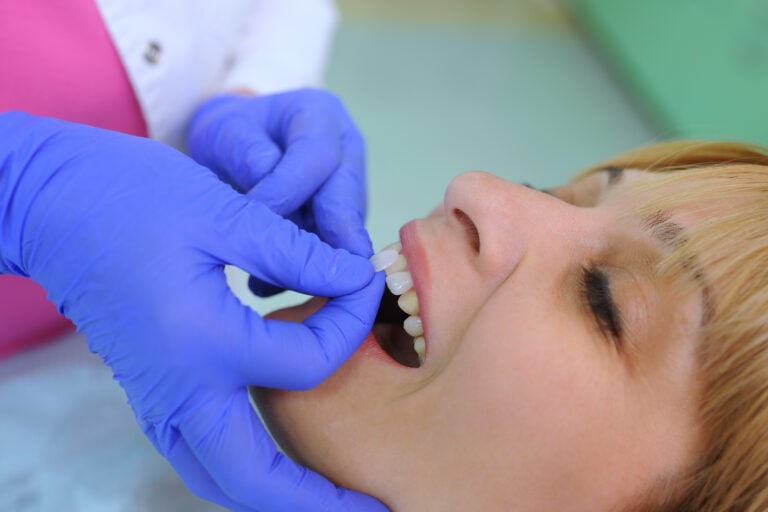
Are you looking to improve the appearance of your front teeth? Dental veneers are widely used to improve the appearance of front teeth and are a much more conservative option than a full dental crown. Veneers can be used to improve the appearance of staining, large gaps, large fillings, chipped teeth, or overall shape. Veneers are a thin covering over the front and biting end of the tooth used to restore the beauty of a smile. Over the years we have helped many patients who opted for veneers and now have the confidence to smile again.

Dental veneers are made in a lab from long-lasting porcelain materials. The shade can be chosen to a desirable color to whiten the appearance of your smile. Dental veneers are usually placed on the anterior, or front teeth, where the chewing forces are not as hard as the back teeth. The process of placing veneers is relatively easy requiring only two dental appointments. In some cases, only one appointment is needed. It depends on the fabrication process.

The first appointment is to “prep” the teeth and take an impression to be sent to a lab to fabricate the veneers. Veneers are fairly conservative in the preparation as it requires a small amount of space to be created on the face (front), bottom, and sides of each tooth to allow space for the veneer to be placed and look natural. You will leave the office with temporary veneers for the next week or two while the permanent veneers are being made.

The second appointment is to place the veneers and make minor adjustments if needed. What a difference it makes in the appearance of the teeth! If you’re interested in learning more, give Dr. Huiras a call today!


Patient Login|Home|Our Team|New Patients|General Dentistry|Services|Contact Us|Site Map